
We have all been there. You bend over to tie your shoes, and the back of your legs feels like taut guitar strings. Your immediate instinct is to stretch your hamstrings. You spend weeks touching your toes and doing yoga, yet the tightness always returns the very next day.
If this cycle sounds familiar, there is a scientific reason your stretching routine isn’t working: You might not have a muscle problem at all. You might have a nerve problem.
In modern physiotherapy, one of the most common misconceptions is treating every sensation of “tightness” as a shortened muscle. Today, we are going to dive into the hidden world of neurodynamics and explain why your nervous system might be the real culprit behind your chronic stiffness.
The Body’s Continuous Thread
To understand why stretching fails, we first need to visualize the nervous system. Most people imagine nerves as invisible, electrical signals. In reality, your nervous system is a continuous, physical structure.
Think of it as a single, uninterrupted cable running from the top of your brain, down through your spinal cord, and branching out all the way to the tips of your toes and fingers.
When you move, this entire system has to move with you. If you bend forward to touch your toes, the spinal cord and the sciatic nerve running down your leg must literally stretch and slide through the surrounding muscle and fascia. We call this “nerve gliding.”
Why Nerves Fake Muscle Tightness
Here is the crucial difference between muscles and nerves: Muscles are like rubber bands; they are designed to stretch. Nerves are like shoelaces; they have very little elasticity. They prefer to slide.
If a nerve becomes irritated, pinched, or restricted (due to prolonged sitting, a minor disc bulge, or localized inflammation), it loses its ability to glide smoothly. When you bend over and accidentally pull on that irritated nerve, your brain panics.
To protect the fragile nerve from snapping, the brain instantly fires an SOS signal to the surrounding muscles (like your hamstrings or calves), ordering them to lock up and act as a splint.
That intense “tightness” you feel is not a short muscle. It is a neurological parking brake.
The Danger of Pushing Through the Stretch
When you assume this protective tension is just a tight muscle, you might try to aggressively stretch it out.
If the underlying issue is neural tension (like early-stage sciatica or a sensitized lumbar spine), holding a static stretch actually pulls the irritated nerve even tighter against the tissues that are trapping it.
You might feel temporary relief right after stretching due to the release of endorphins, but the brain quickly realizes the nerve is under threat again. By the next morning, it clamps the muscles down even harder. This is why you feel trapped in an endless loop of stretching with zero long-term progress.
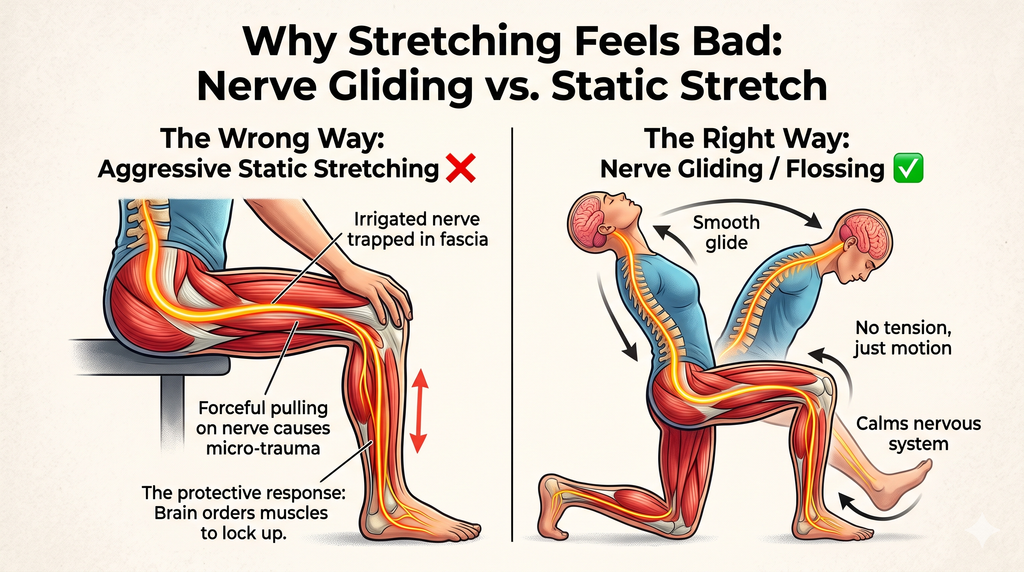
The Solution: Flossing Instead of Stretching
If you suspect your tightness is neural rather than muscular, the solution is not to stretch the nerve, but to “floss” it.
Nerve flossing (or neural gliding) is an evidence-based clinical technique used to gently mobilize the nerve through its pathway without putting it under aggressive tension.
Imagine a piece of dental floss stuck between two teeth. You don’t just pull hard on both ends to free it; you pull on one end while letting go of the other to slide it back and forth. Nerve flossing works the same way. By moving two joints simultaneously—for example, extending your knee while looking up at the ceiling, and then bending your knee while looking down—you gently slide the nerve back and forth without stretching it.
How to Rethink Your Recovery
The next time you feel chronic tightness that refuses to go away with standard stretching, stop trying to force the muscle to lengthen.
- Stop aggressive static stretching on the stubborn area for a week.
- Prioritize dynamic movement and walking, which naturally promote blood flow and gentle nerve gliding.
- Look at the spine. Often, peripheral tightness in the legs or arms originates from a minor mechanical restriction in the lower back or neck.
Your body does not create tension by accident. Before you try to stretch it away, take a moment to ask what your nervous system is trying to protect.