
For decades, we have been conditioned to believe in a singular, ideal way to sit and stand. “Sit up straight,” “pull your shoulders back,” and “stop slouching” are commands etched into our minds from childhood. A massive industry of ergonomic chairs, posture correctors, and specialized braces has been built around the idea that deviations from a rigidly straight spine lead directly to pain and injury.
However, modern biomechanics and physical therapy research are painting a very different picture. The truth about posture is far more dynamic, forgiving, and liberating than the rigid rules of the past.
The Biomechanics of the Human Spine
The human spine is not a rigid tent pole; it is an incredible, adaptable structure made of 33 vertebrae, separated by shock-absorbing discs, and supported by a complex web of muscles and ligaments. It naturally features three curves (cervical, thoracic, and lumbar) that act together like a coiled spring to absorb impact and distribute weight.
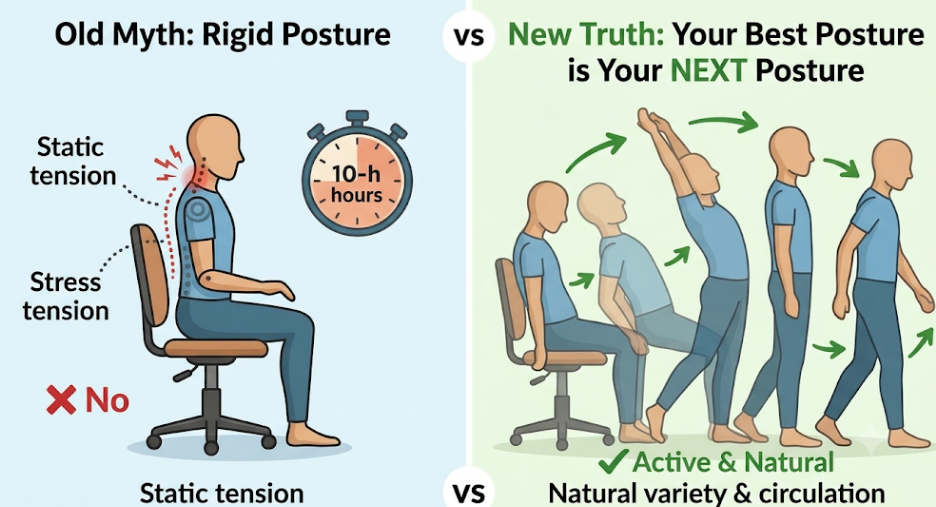
When we force ourselves into a rigidly “straight” posture, we often over-activate muscles that are not designed for prolonged static holds. This continuous muscle tension restricts blood flow and can actually cause the stiffness and pain we are trying to avoid.
Key Clinical Insight: Pain rarely comes from the shape of your posture. It comes from the duration you spend in it.
The Problem with “Static Perfection”
Imagine holding a lightweight dumbbell in your hand. If you do a bicep curl and put it down, your arm feels fine. But if you hold that same lightweight dumbbell in a static, isometric position for two hours, your arm will scream in agony.
The same principle applies to your postural muscles. Even if you sit in the most ergonomically “perfect” position imaginable, holding that exact position for eight hours straight will lead to tissue ischemia (lack of oxygenated blood flow), muscle fatigue, and discomfort.
Slouching, on the other hand, is not inherently dangerous. It is a natural human resting position that unloads certain muscle groups. The problem arises only when slouching becomes the only position your body knows.
Why “Text Neck” is Largely Misunderstood
You have likely seen the terrifying graphics showing how looking down at your phone puts “60 pounds of pressure” on your cervical spine. While the physics of load distribution are technically correct, the narrative ignores a crucial biological fact: human tissue adapts to the loads placed upon it.
Your neck is robust. It is designed to look down—whether you are reading a book, preparing food on a kitchen counter, or checking your phone. While prolonged, uninterrupted phone use can cause temporary muscle strain, there is no strong clinical evidence linking looking down at a phone to long-term spinal degeneration. The solution is not to buy an expensive neck brace, but simply to move your neck through its full range of motion periodically.
3 Rules for Building Postural Resilience
Instead of obsessing over staying straight, focus on building a resilient, adaptable body. Here is how to reframe your approach to daily movement:
1. Embrace the “Next Posture” Rule
The best posture is always your next posture. Set an environment that encourages constant micro-shifts. Sit cross-legged for a while, lean back, stand up, and yes, even slouch. The goal is to rotate the mechanical load across different tissues throughout the day so no single muscle group becomes overworked.
2. Focus on “Movement Snacks”
You don’t need a grueling one-hour workout to undo a day of sitting. Implement 2-minute “movement snacks” every hour.
- Perform 5 simple desk squats.
- Do a set of wall push-ups.
- Extend your spine over the back of your chair. Frequent, low-intensity movement breaks act as a reset button for your nervous system and restore blood flow to static tissues.
3. Build Capacity, Not Correction
Instead of trying to externally correct your posture with braces (which actually weaken your muscles over time by doing the work for them), build your internal capacity. Strength training—particularly exercises that target the posterior chain like rows, deadlifts, and back extensions—increases your body’s tolerance to daily physical stress. A strong back can tolerate being in a “bad” posture much longer than a weak back can.
The Bottom Line
Your body is not a fragile machine ready to break because you sat asymmetrically for an afternoon. It is a highly adaptable, robust ecosystem that thrives on variety. Stop feeling guilty about how you sit on the couch, throw away the rigid posture correctors, and start focusing on moving your body in as many different ways as possible throughout the day.